There has been some focus in recent weeks and months on the alarming decline in the numbers of students choosing to study English Literature at A’level – and a long term and ongoing decline in reading for pleasure.
I wonder if we should consider to what extent our approach to text as English teachers is contributing to this decline. Are we – and I‘ve been accused of this by at least one angry 15 year old – hammering the joy out of reading?
In my work – producing teaching materials for commercial publication – resources usually focus on extracts rather than whole texts: 200-500 words of a novel or short story, newspaper article or non-fiction book. The purpose of those extracts is to focus on specific features of text and on specific skills – potentially filling those gaps that the full-length texts we choose to teach cannot reach. The choice of extract in this context is vital to the resource’s success. If the objective is to focus on figurative language, the extract will need to feature simile, metaphor and personification. If the objective is to focus on persuasive language, the extract will need to include as many key features as possible: emotive language, a rhetorical question, a list, a triple structure, direct address, and so on. And if any of those are not present in the text, they will either remain untaught or have to be awkwardly bolted on.
For teachers, text selection brings the chicken-and-egg decision of whether to find an engaging, accessible text and explore the skills it enables us to explore and develop in the classroom… or to begin by identifying the skills we want to explore and develop and then find an engaging, accessible text that allows us to explore them. The former – beginning with the text, purely because it is accessible and engaging – can lead to a random and haphazard programme of skill-building. Yes, you might cover everything that needs to be covered. But not necessarily in the right order.
Building an effective curriculum is essential in supporting your students at KS3 and GCSE. An effective curriculum cannot be built on a foundation of text choice – it must be built on a logical and recursive progression of skills-building. The texts you choose should support, not dictate, that progression.
So the first question when choosing a text – whether a novel, a play, a poem or a newspaper article – is ‘How does it fit into my curriculum?’ If the answer is ‘Erm… it doesn’t really…’, then that’s not the text for you. But if you struggle to answer the question at all, then it is highly likely that your curriculum needs further development before you’re ready to make effective text choices. Yes, text choice is important. But there are more important questions to ask before you make that choice.
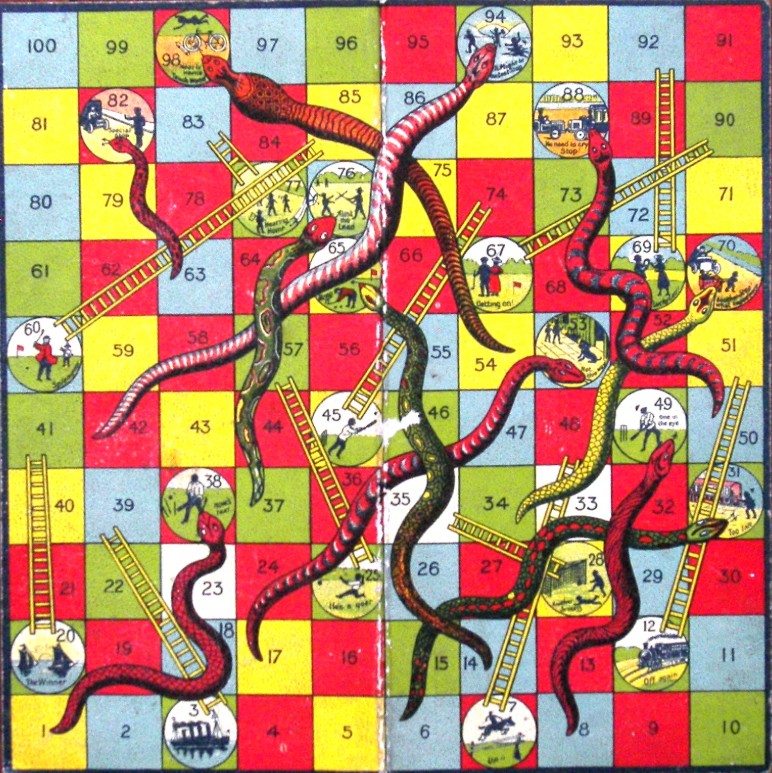
A curriculum-driven process of text hunting and text choice at Key Stage Three can be frustrating. It’s a game in which you’re constantly hoping for ladders but, far more frequently, getting snakes and being sent back to ‘Go’ to start the hunt all over again. But if your curriculum is clearly defined, and you have the patience and time to match texts precisely to it, then students will be as ready as they possibly can be to tackle the variety of texts that GCSE English Language and Literature will throw at them.
A longer version of this article appeared in issue 36 of HWRK magazine at https://hwrkmagazine.co.uk/read/
Leave a Reply