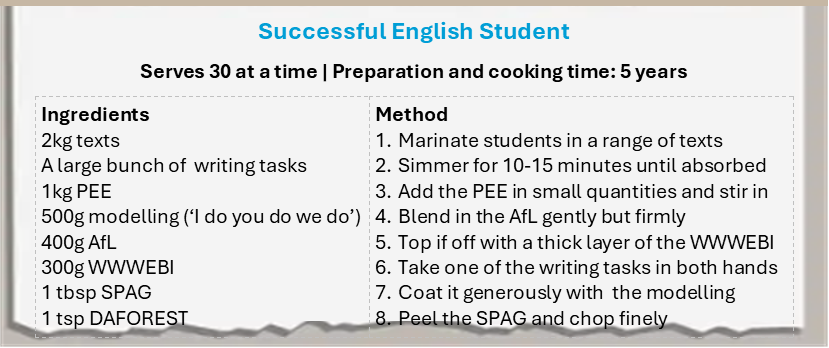
Over the last 20 years, it feels as though English teaching has become driven and dominated by pedagogical research, rigidly formulated and formulaic approaches and strictly defined, classified and codified practice.
English teachers have long drawn on a range of approaches but not necessarily applied them using research-based equations, with a promised outcome of a beautifully educated class. Experienced English teachers are like chefs. They know the ingredients in their store cupboard from the top shelf to the darkest corner; they know when to flambé and when to deglaze, when to whisk vigorously and when to fold gently with a wooden spoon, when to get out the bain marie and when to grab the blowtorch; when to bring to the boil and when to turn down the heat.
Chefs don’t follow recipes. They respond to the needs of their customers, tasting and adapting and adjusting as the dish progresses through the kitchen. Experienced English teachers do the same. They adapt their teaching approach to their students’ moods on that particular day, to the specific learning needs and objectives of that particular day, to their students’ progress and grasp of those objectives (or lack of it) on that particular day.
PEE (or PEED or PETAL or the many other varieties of paragraph structure scaffolding) is a simple, if well worn, example of a formulaic approach that backfires. An effective critical response to a text definitely needs each of these ingredients – the P and the E and the other E. But applying the PEE recipe ruthlessly and rigidly results in a bland and mechanical response.
So the best advice I can give to students and to English teachers is: know your ingredients, know the dish you want to create, but follow your own recipe.
English teachers need a massive ingredients store. This store, and the knowledge of when and how to use each ingredient within it, grows with experience. My concern is that the rigid application of acronyms and approved pedagogy stifles the freedom that English teachers need to grow.
If all you do is re-heat and re-serve the same recipe, the customers may feel disappointingly empty by the end of the meal. Or worse, they may walk out before pudding.
Come dine with me – for free resources (coming soon), for consultancy, for general witterings and rants about English teaching – here.
Leave a Reply